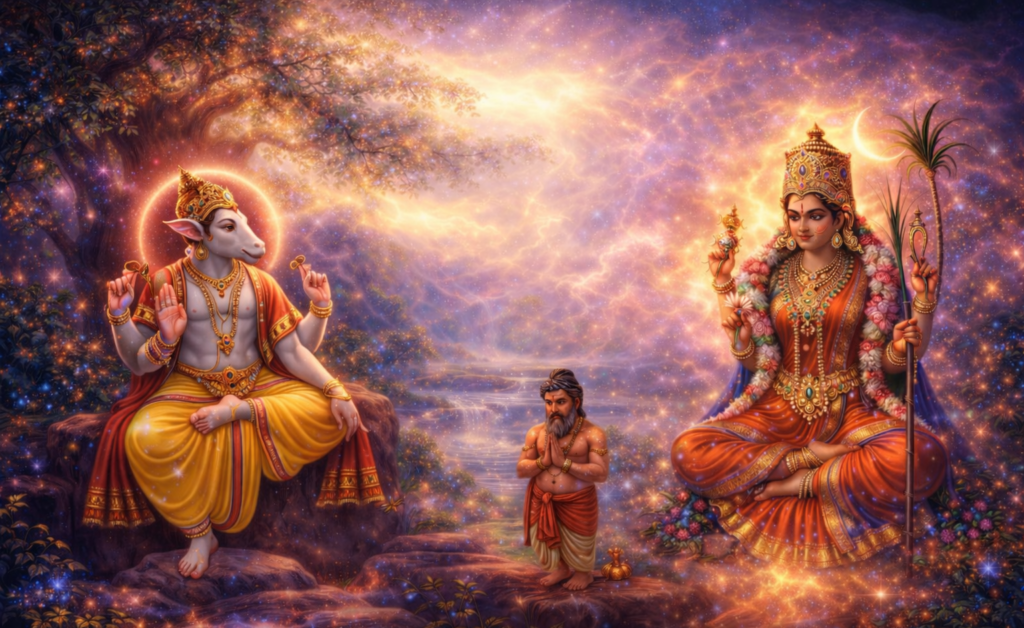
Lalitopakhyanam comes at the end of the Brahmanda Purana and It comes across as purposeful, not random. It feels architectural, deliberate. Like the inner shrine of a temple one reaches only after walking through the halls and courtyards. By then, one is ready for something quieter, deeper.
The first chapter opens with a conversation – Agastya speaking with Hayagriva, the horse-headed form of Vishnu. It isn’t just a formal exchange of words. It is almost like the start of something being slowly revealed. What begins as a dialogue gradually becomes a revelation, a hint of a journey of devotion that is subtle, internal, and not necessarily clear to all.
Hayagriva doesn’t circle around the answer. His response is direct, nothing surpasses the worship of Sri Lalita Tripurasundari. No elaborate framing. No checklist of eligibility. No carefully staged ascent. Just her name, Sri Lalita Tripurasundari, as if nothing more needs to be added and then the teaching widens. She is not introduced as one deity among others. Not another luminous figure in a vast pantheon. She is Para Shakti – the underlying force without which nothing functions. Brahma creates because that force moves through him. Vishnu sustains because that balance steadies him. Shiva dissolves because that same power withdraws.
Without her, even the gods would not act. The force behind everything that begins, continues, and ends. The energy behind all things which originate, persist, terminate. Underlying every reality, there is consciousness. Brahma creates because her impulse stirs. Vishnu sustains because her equilibrium holds. Shiva dissolves because her withdrawal completes the cycle. All three aspects of the universe are aspects of universal consciousness, so they are all one with no separation.
Sri Matre Namah ॥
No responses yet