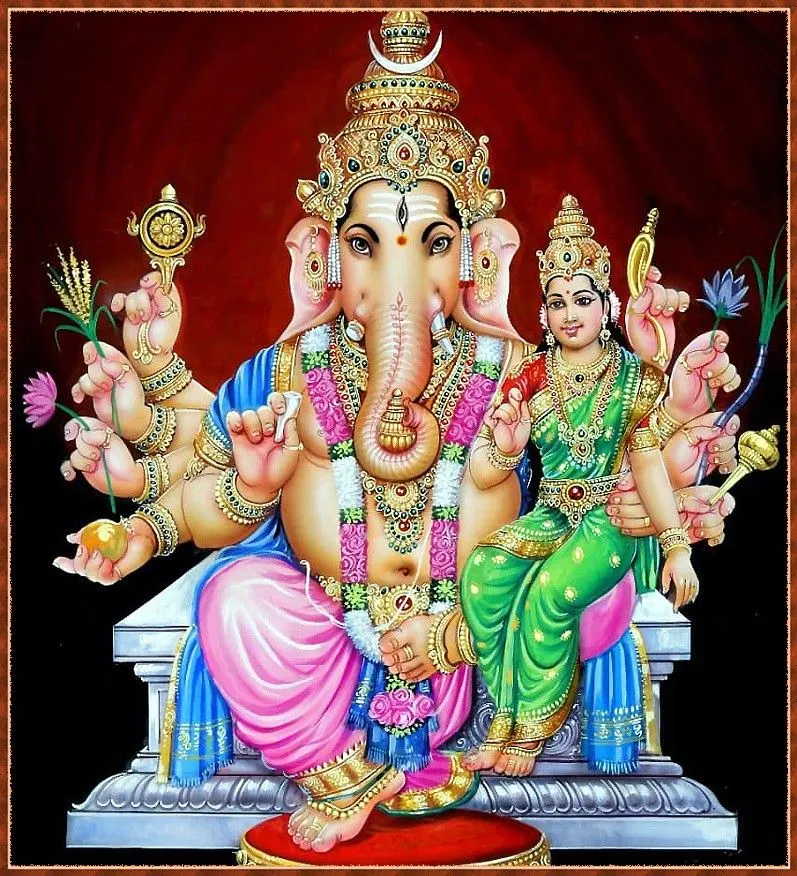
With deepest reverence, I offer this explanation of the Mahaganapati Dhyana Shloka exactly as I received it from my revered Gurudev Sri Atmanandanatha of the sacred Guhananda Parampara, the lineage of Shri Vidya Tantra.
These insights do not belong to me; they belong entirely to Him.
They are His revelations, passed down through the lineage with clarity, compassion, and the living presence of Sri Vidya.
This article is only a humble attempt to place His teachings into written form — without adding anything, without removing anything, and without altering even the slightest essence of what He bestowed.
May this sharing carry even a small reflection of the light with which it was taught.
Mahāgaṇapati Dhyāna Śloka
बीजापूर गदेक्षु कार्मुक रुजा चक्राब्ज पाशोत्पल
व्रीह्यग्र स्वविषाण रत्नकलश प्रोद्यत्कराम्भोरुहः।
ध्येयो वल्लभया सपद्मकरया श्लिष्टोज्ज्वलद्भूषया
विश्वोत्पत्ति विपत्ति संस्थितिकरो विघ्नेश इष्टार्थदः॥Bijapura gadekshu karmuka ruja chakrabja pashotpala
Vrihyagra sva vishana ratna kalasha prodyat kara ambhoruhah: ।
Dhyeyo vallabhaya sa padma karaya shlishta ujjvala dbhushaya
Vishvotpatti vipatti samsthitikaro Vighnesha ishtarthadah : ॥
Bijapura (बीजपूर) — The Seed Principle
The vision of Mahaganapati begins with Bijapura, the citron fruit.
In Sri Vidya, every journey begins from the seed — the bija, the undivided source.
A seed is not merely a physical object; it is the doorway to creation.
It grows, it expands, it contains within itself the entire blueprint of manifestation.
Thus Bijapura points directly to Bindu, the causal point where Srishti (emergence) begins and where Samhara (dissolution) returns.
Everything arises from Bindu.
Everything dissolves into Bindu.
Bijapura represents this primal root of existence.
Gada (गदा) — The Power to Break Inertia
Next appears the Gada, the mace.
In Sri Vidya understanding, Gada is not merely a weapon; it is the force that breaks inner heaviness.
It signifies the shattering of tamas — that dense prarabdha which binds consciousness to its own limitations.
When Gurudeva explained Gada, he described it as the power that destroys the strongest fixed karma,
and for a Sri Vidya upasaka, Gada becomes the Guru’s anugraha, the compassionate power that breaks the knots that bind the seeker.
It is the first movement of liberation — the breaking of stagnation.
Ikshu (इक्षु) — The Sugarcane Bow
Following the Gada comes Ikshu, the sugarcane bow.
In Sri Vidya, Ikshu is not only the sugarcane itself; it symbolizes the inner softness and devotional warmth that naturally arise in the sādhaka’s heart. Sugarcane is firm on the outside yet holds a gentle essence within, just as a seeker maintains steadiness while carrying deep devotion.
Ikshu is this manarūpa ikshu — the heart’s devotional inclination. When Mahaganapati holds Ikshu, it signifies His complete mastery over the seeker’s emotional nature. He guides it, shapes it, and sanctifies it.
Ikshu also points to a gentle inwardness — the ability to turn the senses and mind inward without pressure or force. Placed after the Gada, it simply shows that while the Gada breaks inertia, Ikshu represents the devotional softness and inner receptivity present in the sādhaka.
Thus Ikshu reveals that spiritual growth is not only about breaking tamas, but also about awakening a steady, inward-flowing devotion — something Mahaganapati Himself nurtures and completes within the seeker.
Karmuka (कार्मुक) and Ruja (रुज) — The Bow and Arrows
Karmuka is the bow.
A bow is used to release the arrow, right? And for that, it must have flexibility.
Exactly this quality is what the bow stands for.
This bow symbolizes Iccha Shakti.
Karmuka is one-pointed desire aligned with Shakti.
That is the meaning of Karmuka.
At the same time, the bow also indicates the power to project reality — the Shakti of Srishti.
From intention, creation unfolds.
This too is Karmuka.
Ruja refers to the arrows released from this bow.
When the bow is Iccha Shakti, Ruja becomes the directed movement of that will — the sharp, purposeful extension of intention that goes straight toward its aim.
Thus Karmuka and Ruja together show both the inner alignment of desire and the outward expression that follows from it.
Chakra (चक्र) — The Radiant Disc
The Chakra represents Jnana Shakti.
And what happens when Jnana Shakti awakens?
Discrimination arises — not the discrimination that judges people, but the discrimination within oneself, the capacity to clearly see what is real and what is not.
This is the discriminating power that cuts through ego.
The Chakra cuts the ego.
That is its true force.
The Chakra rotates, and this rotation signifies trial, the constant process of learning and refinement through experience.
Because of this revolving nature, the Chakra also symbolizes mastery over the three cycles of time.
Mahaganapati stands as the one who knows the past, the present, and the future.
Abja (अब्ज) and Utpala (उत्पल) — The Lotus and the Blue Lotus
Abja is the lotus, and Utpala is the blue lotus.
The lotus grows in murky waters, in mud, yet it remains completely unstained.
This quality of remaining untouched, even while surrounded by impurity, is the symbol of Viveka.
Viveka too stays pure, no matter what circumstances it grows through.
And what does the blue lotus represent?
It points to something deeper — deep intuitive awareness, the subtle insight that arises from within, beyond reasoning.
Thus Abja signifies Viveka, and Utpala signifies intuitive wisdom, both essential qualities on the inner path.
Pasha (पाश) — The Noose of Bondage and Withdrawal
Pasha is the noose — the binding power.
In our daily life, this Pasha constantly operates as the force of samskaras.
One becomes bound by the Pasha of relationships, the Pasha of responsibilities, the Pasha of possessions, and the countless impressions that shape one’s tendencies.
These bindings keep the mind turned outward, pulled again and again into habitual patterns.
Yet, when this same Pasha is held by Ganapati, its nature is transformed.
In His hands, Pasha becomes Samyama Shakti, the capacity to gather the scattered mind and draw it inward.
The very force that once held the seeker to samskaric patterns now becomes the power that concentrates awareness and redirects it toward its origin.
Thus Pasha represents both the bondage of conditioning and the inward-turning strength that arises through Ganapati’s grace —
a power that leads the seeker back to inner stillness.
Vrihyagra (व्रीह्याग्र) — The Tip of Rice Grain
Vrihyagra is the tip of the rice grain, something we use for food.
Gurudeva explains that because it nourishes the body, it becomes the symbol of Annamaya, the sheath made of food.
From Annamaya then begins the evolution toward Pranamaya, the awakening of the life-force.
Thus Vrihyagra represents prosperity, nourishment, and the stability of prana, the essential foundation for every seeker.
Sva Vishana (स्वविषाण) — His Own Tusk
Sva Vishana refers to His own tusk.
Gurudeva explains that Mahaganapati broke His tusk to write the Mahabharata, a sacred act of sacrifice and purpose.
By offering His own tusk, He demonstrated the power to break duality — letting go of one part to reveal the single, non-dual truth, the Ekānta–tattva hidden beneath all appearances.
This single tusk becomes the symbol of that one-pointed reality, the state where the mind no longer wavers between two.
It also represents OM, the essence of the Ganapati bija mantra, the vibration where dual tendencies dissolve.
Sva Vishana reminds the seeker that true wisdom sometimes requires sacrificing a part of oneself so a higher insight may emerge.
Ratna Kalasha (रत्नकलश) — The Gem-Filled Pot
Ratna Kalasha is the pot filled with precious gems.
Gurudeva explains that ratna signifies what is rare, luminous, and auspicious, and kalasha is the vessel that holds this overflowing grace.
This radiant pot represents saubhagya, the natural abundance that arises from inner alignment.
The gems within it are the navaratnas, each one nourishing the nine āvaranas of the Sri Chakra.
Just as the Sri Chakra unfolds layer by layer, these gems symbolically sustain every subtle enclosure of consciousness.
The Ratna Kalasha does not merely indicate material prosperity.
It signifies the inner wealth of the sādhaka — clarity, steadiness, devotion, discrimination, and strength — the gems of awareness that support spiritual evolution.
In the presence of Mahaganapati, this kalasha overflows, showing that when ego dissolves and the inner channels open, auspiciousness becomes a natural, effortless flow.
Thus the Ratna Kalasha stands for the ever-present grace that nourishes the seeker at every stage of the inner journey.
Prodyat Kara Ambhoruhah (प्रोद्यात्कराम्भोरुह) — Hands Like Blossoming Lotuses
Prodyat Kara-ambhoruhaḥ means shining lotus-like hands.
Gurudeva explains that this image shows the source from which all these powers arise.
Just as a lotus remains pure even while growing in mud, the hands of Mahaganapati symbolize pure consciousness, untouched and unstained.
When the shloka describes His hands as lotus-hands, it means that every power mentioned earlier — Iccha Shakti, Jnana Shakti, Kriya Shakti, nourishment, intuition, discrimination — all arise from that pure consciousness.
They do not come from ego or effort, but from the natural radiance of awareness itself.
Vallabhaya (वल्लभाया) — Ganapati With Vallabha
Vallabhaya refers to Mahaganapati in union with Vallabha.
This form reveals the state of Shiva–Shakti aikya — the inseparable unity of consciousness and energy.
It is the inner joining of Vāk and Artha, sound and meaning, the power that speaks and the reality it points to.
It is also the union of Kundalini and Bindu, the rising force and the causal point from which everything emerges.
In this form, Vallabha holds a lotus, signifying the awakening of Anahata Shakti, the gentle opening of inner auspiciousness.
Together, Ganapati and Vallabha show the harmony of all dual principles — awareness and action, intention and manifestation, stillness and movement.
This is not an external union but an inner state the seeker must discover within themselves.
Vallabhaya therefore expresses the completeness of Ganapati, where all polarities dissolve into a single, balanced wholeness.
Shlishta-ujjvala-dbhushaya ( (सृष्टि, स्थिति, लय) — The Three Movements
Gurudeva explains that Ganesha is Parabrahma moving in maya-lila, and within this play, creation, sustenance, and dissolution are constantly taking place. Creation is the projection of experience, sustenance is the way our attention holds that experience, and dissolution is its absorption back into our awareness. All of this happens inside one’s own consciousness. The phrase shlishta-ujjvala-dbhushaya refers to this truth: shlishta means joined, ujjvala means radiant, and dbhushaya means adornment. Together, the phrase points to the radiant unity of creation, sustenance, and dissolution happening within us, revealing the natural brilliance of Ganesha as Parabrahma acting through these three movements.
Vishvotpatti-Vipatti-Sansthitikaro (विश्वोत्पत्ति-विपत्ति-संस्थितिकरो)
“Vishvotpatti-Vipatti-Sansthitikaro” describes Mahaganapati as the One who creates, sustains, and dissolves the universe. Creation is the projection of experience, sustenance is the attention that holds that experience in place, and dissolution is its absorption back into awareness. As Gurudeva taught, all three movements unfold within one’s own consciousness; nothing happens outside it. Mahaganapati is the presence behind these processes — the source from which experiences arise, the force that maintains them, and the stillness into which they finally return.
Vighnesha (विघ्नेश) and Ishtarthadah (इष्टार्थदः)
Symbolically, Ganesha creates obstacles to correct our karmic orbit. When something in us is moving off-course, the obstacle appears to bring us back into alignment. And when alignment is achieved, the same obstacle is removed. That is why He is Vighnesha — Vighna + Isha — the one who is both the obstacle and the remover. Both the blockage and its clearing arise from the same field of consciousness.
Ishtarthadah means the giver of the desired fruit, but not through miracles. The result comes through inner realignment — stabilizing prana, dissolving samskara-pashas, and awakening Iccha, Kriya, and Jnana Shaktis. When these inner energies settle into harmony, the desired outcome naturally unfolds.
As this explanation of the Mahaganapati Dhyana Shloka comes to a close, I offer my deepest gratitude to my Gurudeva Sri Atmanandanatha and the Guhananda Parampara of Shri Vidya Tantra. Everything shared here belongs to that sacred lineage. Whatever clarity these words may bring arises from the light of their teaching. Any limitations in expression are mine alone.
The symbols described in this shloka are not merely external details of a divine form; they are inner movements of consciousness. Each object in Mahaganapati’s hands reflects a stage of our own journey — the breaking of inertia, the refinement of intention, the awakening of discrimination, the balance of strength and sweetness, the grounding of prana, the cutting of duality, and the opening of auspiciousness within.
Mahaganapati stands as the one who guides us through all these transformations. He is the force that corrects us, the grace that supports us, and the presence that removes the very obstacles He places when their work is done. Ultimately, He leads the seeker back to the quiet center where creation, sustenance, and dissolution are seen as movements of one consciousness.
May Mahaganapati bless every seeker with clarity, strength, and inner alignment.
May the Guru’s light continue to illuminate the path within.
Sri Mahaganapataye Namah.
Sri Gurubhyo Namah.
No responses yet